Photo Credit: http://www.bata.com/bata-in-indonesia.php

Friday, August 10, 2012

Music - An International Language

Written on 7/27/12

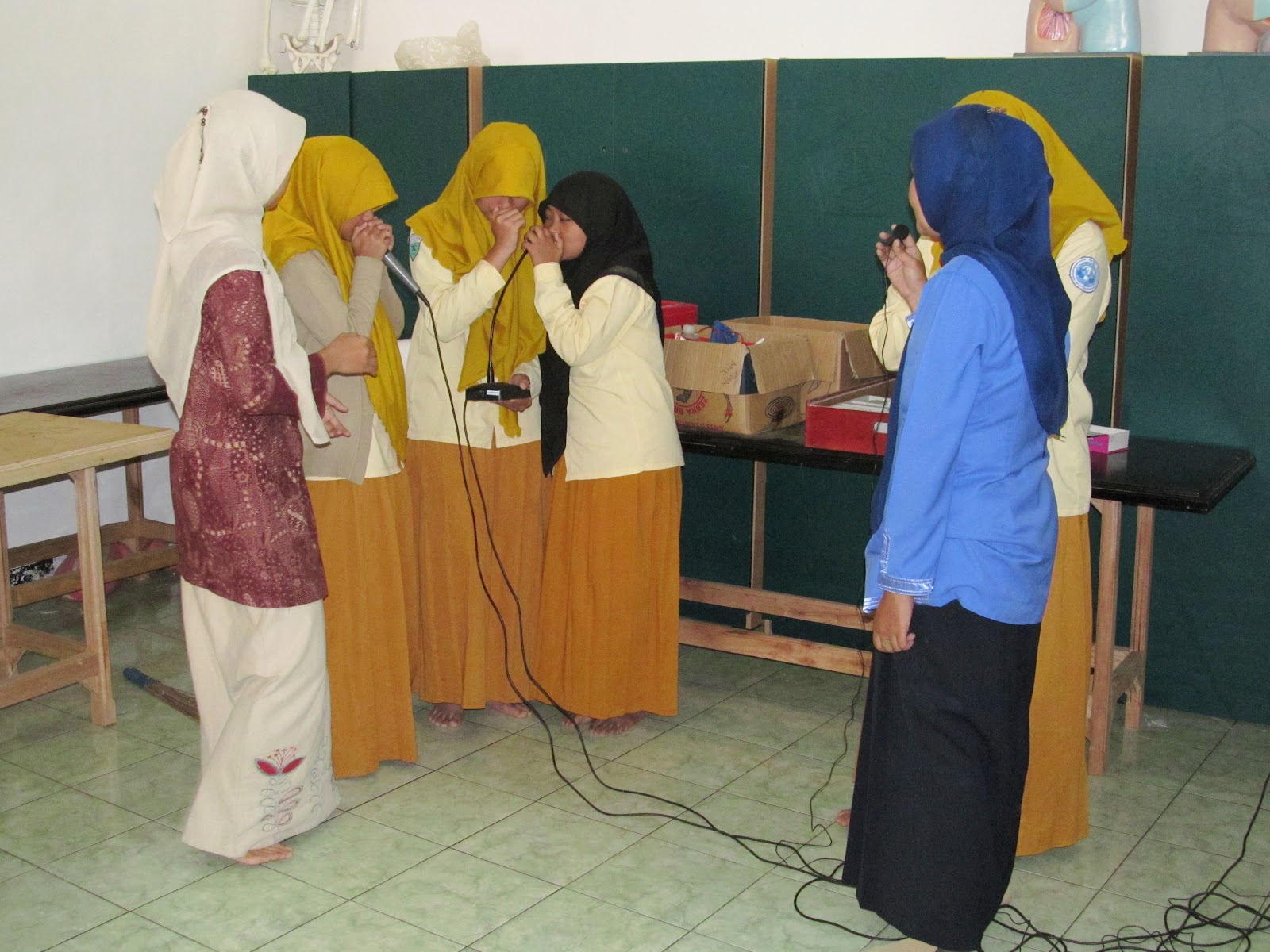
One of the newer young teachers at MBI is a very motivated woman nicknamed Bella.  Today she was to work with the choir groups.  The girls' group would have a competition on Saturday.  They needed to have a good final practice today.  It would turn out to be the boys’ practice day as well, however their competition wouldn’t be until Sunday.  Since the visiting and observing of classes, by now, seemed to be a decision left up to Nancy and me, I decided to spend time with the choir classes.  The first thing necessary was the finding of a space to use.  A room was found, but needed to be cleared and cleaned.  Sound equipment was brought in and set up.  Students and teachers struggled with the equipment.  Only some of the mics worked consistently. 
These girls were ready to begin before
the remainder of the choir arrived.
I checked in to see how the competition went when I saw the girls two days later.  I learned that the girls took a second place.  Very nice job, Ladies!

The piece begins with a traditional,
melodic sound, but mixes in a little
beat-boxing and catchy rhythm.
The boys' choir group's competition is
not eminent, so they goof around a bit
more than the girls.
Because I am American, and these teens listen to and know how to sing many American songs, they serenaded me with a couple of familiar favorites.  My students will really connect with them. 

After spending much of the morning with the choir groups,
I realized that they know some songs my own students would
recognize.  They agreed to sing one on video for my students
and write out the lyrics.  (I agreed to show it only to my students.)
Perhaps one surprising thing for me this day was that the music the students and teachers chose was fun and foot-tappingly addictive.  Since I agreed to show the videos only to my students, I won't post them here, but you can find the American songs they sang at these links:  Second Hand Serenade, Fall for You, and Adele's, Someone Like You. 

Sunday, July 29, 2012

International English Teaching Strategies Workshop


Written 7/26/12
Discussing best practices
On Thursday, July 26th, Nancy and I presented a workshop for English teachers from as far away as Surabaya.  Because of traffic, it took those teachers five hours to drive to Mojokerto to attend.  I’m honored that they came.  H. Achmad Chudhori, M. Pd., or Che Chep, the principal of MBI, requested a workshop that included strategies for engaging students in English language learning.  We were happy we could provide this kind of service.  Approximately 25 teachers were present.  Indonesian teachers already have many strategies in common with American teachers.  Some examples are:  The use of printed and electronic media, debates, interviews, small groups, and games.

Indonesian English teachers watch the
TJTV student video bulletin from my school.
Veteran teacher, Didiek, talks about what works
in his English classes.
Teachers practice the "Four Corners" strategy.


Indonesian teachers actively participated in our demonstration lessons.  Some were quite passionate about responding to discussion prompts and their senses of humor about working into the evening on a school day were just like teachers at home.  We began at 2:00 p.m., and with one 20 minute break, continued until it was time to break-fast at 5:30 p.m.  This time together confirmed something I already knew, and that is that teachers are in this business because they care about kids.  It feels like we made some new and broader connections in our global professional learning community.  The following day, I visited a 12th grade boys’ English class.  The teacher, who had been present at the strategies workshop, used small groups and a competitive game to instruct simple past tense.  The boys were very engaged.  Another English teacher told me later that day that he was going to use the spectrum activity.  Such willingness to try new ideas!  The principal has plans for a professional learning community of regional English teachers in which the exchanging of ideas will continue.  I wish I could be here to see its development, but I know these teachers and administrators will implement a wonderful program that ultimately enhances student success.

I think I can now put a new event on my resume, the presentation of an international English strategies workshop.  Sounds pretty impressive, eh?

Our very helpful hosts, Tutik and Nizzam.


Wednesday, July 25, 2012

U.S. Mail Delivered

Written 7-/24/12

This school day was very rewarding.  I finally got a chance to deliver some of the letters, videos, and cultural lessons I had worked on during this past school year with my students.  They would be so proud to see their letters being read and shared aloud with students on the opposite side of the globe.  Nancy and I were invited to run an activity at the English Club meetings.  This turned out to be a perfect time to pass out letters from our students.  We had students read the letters in pairs or triads.  The “listener” had to report to the rest of the students about the American student who wrote the letter.  It was a great exercise for reading, listening, and speaking English.
7/26/12
I have, by now received letters from some of our Indonesian students to take back.  My heart is full.  For many months my students and I anticipated this global connection, and to watch students here engaged in the messages that my students have sent is all the reward I need. 


Ramadan


<><> <><> <><>
Morning prayers
Written 7/24/12

On Java, well over 90% of the people follow Islam.  Followers are called Muslims.  Because most of the Indonesian population is Muslim, and this month is Ramadan, a significant difference in their lifestyle is taking place.   Islam began with Muhammad, who lived in Mecca and Medina in the 600s AD.  He is said to have been visited by the angel, Gabriel, who revealed to him the word of God (Allah).   Muhammad told the words of God, first to his family, then to his friends, and finally to his community.  One important message he carried was that there is only one god.  Before this, people in the Middle East worshiped many gods and placed images of them at a temple in Mecca said to have been built by Abraham.  Good Muslims do five important things.  They are called the Pillars of Islam.  First, they must declare the there is only one god.  His name is Allah, and Muhammad is his prophet.  Second, Muslims must pray five times each day facing the city of Mecca, where the Kaaba (the temple Abraham built) is located.  Third, Muslims give charity.  Fourth, they fast during the month of Ramadan.  Finally, Muslims must participate in the Hajj, a pilgrimage to Mecca where they perform tasks that recalls the life of Muhammad.  This  pilgrimage is only required if it is possible. 

Preparing meals for the evening break-fast
I am learning , first-hand, what Ramadan means to Muslim students.  At this school, a Madrasah (private religious school), students wake up in time to be present at an assembly by 3:00 a.m.  Prayer is said and sung, and announcements are made.  After this, since it is still dark, students may eat a morning meal.  Once dawn breaks, there will be no more eating or drinking until the fast is broken after the sun sets.  Still, the important school day awaits.  The first of four 90-minute classes begins at 7:30 a.m.  After second period, students get a 15-minute break.  Because students awoke so early, and because they are not eating, they usually sleep during the break.  I tried not to take it personally when I was teaching and noticed a couple of students nodding off.  J  I wonder if there is any effect on the learning. 
Though I am living at the school, I am not fasting.  I did think of trying it for a day or so, to be able to empathize with the sacrifice Muslims are making, but gave up that idea.  I take food and water in private if possible.  My hosts are very understanding and have cooked Nancy and I several meals even though they, themselves could not eat them.  In fact, the meals have been very tasty and the portions have been huge.  At this writing we have asked that they only cook dinner for us.  We have collected such a stash of food to snack on in our rooms, that we will need several days to finish it.

Note that cooking class takes place on campus during the day, even though the product may not be eaten until sunset.  Both the boys’ class and the girls’ class prepared food that smells wonderful.  After sun sets, grand meals are served, so preparations begin early.  Imagine having to prepare food that you can’t eat until dark.

The Daily Routine

 Written 7/23/12


Class takes place in many kinds of available spaces
Yesterday was Sunday.  Our arrival day coincided with a parent visitation day.  Amanatul Ummah, International Standard School, or MBI as we know it, is a boarding school.  Parents dedicate their Sundays as a holiday to come and visit.  Of course the students are always very excited to see their families, and chatter abounds on this day.

My living quarters are nearer the middle school than the high school, though the walk is short and beautiful up the hill to MBI.  If I didn’t know it before now, I certainly can now confirm that middle schoolers are louder and sillier than high schoolers.  The environment is quite different on the two campuses.  The patio onto which my room door opens, serves as a classroom for some of the younger boys, so when I am there, I can hear the random and silly goings on.  Admittedly, they are really excited to see American teachers.  Most students greet us enthusiastically, and sometimes giggle when we respond.


The girls' morning assembly
Students assemble at 3:00 a.m. for morning announcements and prayer.  Since it is Ramadan, and fasting begins at daylight, the morning meal is taken after assembly, while it is still dark.  School officials have not asked us to attend so early, though since I don’t sleep through the noise, I could.  We arrive at MBI at 7:15 a.m.; another assembly is in progress at this time, and then classes begin at 7:30.  There are four class periods, with one 15 minute break following period two.  Many of the students take advantage of the break to sleep.  They have, after all, been awake since before 3:00 a.m.  As teachers return to classes after break, they sometimes have to wake up the students to begin lessons.  The school day ends at 1:00 p.m.  Teachers meet, if necessary, and prepare for any extra-curricular activities they sponsor.  This school year has just begun, so student clubs are forming, and student government offices are being filled through a democratic election system.  Candidates for student body president were giving campaign speeches when we arrived yesterday.   Tomorrow our after school event will be the English club’s open house.

It’s 11:40 p.m., and construction on the mosque next door has just stopped, at least momentarily, so blogging takes a back seat to sleep.  More later.


Monday, July 23, 2012

Living the Dream

This terrace follows the road from our room to our school
Written 7/23/12
Waking to sounds of exuberant young people gathering for class, I realized that I am living, however temporarily, the visions I had of Indonesia.  For much of a year, I have anticipated this opportunity to exchange educational and cultural information with the people of Indonesia.  Now at my host school in Mojokerto, this first day of classes has been exhilarating and exhausting.

Photo taken from my balcony
Walking to school from the guest house was beautiful.  After pausing to capture some pictures of the terraced rice fields that grow next to the road, Nancy and I looked up to see that a towering volcano, Welirang, loomed before us.  Images of Indonesia in travel guides, while beautiful, do not do it justice.  How lucky Nancy and I have been to have been assigned to this mountain school. 
Tutik's morning class in the forest


At school, I was graciously welcomed into my host teacher’s girls’ English class.  They were meeting in the forest today.  A tarp on the ground serves as the area boundaries for the class, and even though it is outside, one takes off one’s shoes to “step into the classroom.”  It’s cool here.  We’re at the base of a passive volcano, Welirang, so we enjoy a mountain breeze today.  My student’s will be jealous of the learning environment.  Since the students at this high school do not move from class to class like American students, the girls in this forest classroom are very lucky to be there for all of their classes.  Ibu Tutik let me take up the whole period to talk to the girls about my home in California.  I knew it was time for the next class when the chemistry teacher arrived.   Three more times, in different classrooms, I shared information about my California.  I was careful to explain that my California is quite different than my neighbors’ California, because we are a state populated by people from many parts of the world.  Given some time to think and to get comfortable, students asked some questions as well.  One thing it seems that all Indonesian students know is that our U.S. president is Barack Obama.  Obama attended school in Jakarta when he was young.  Perhaps I’ll get a chance to see that school before I leave the country.
When school was out for the day, English teachers, our principal, and TGC teachers designed a plan for a workshop on Thursday.  English teachers from several nearby schools will be invited to attend, and the sharing of all of our best practices for engaging students in English language learning will be the focus. 

Saturday, July 21, 2012

Indonesian Student Impressions of the United States

Indonesian Student Impressions of the United States

Education Ministry Panel Discussion and Cultural Dinner

Time and a slow internet connection makes comprehensive descriptions of all that we have done and learned challenging currently.  In the interest efficiency, enjoy the videos without my narration just now.
Meeting with Indonesian administrators and Directors 
from the Ministry of Education


Student from Bali performs 
a Balinese dance
Heather represented the
American IREX TGC cohort
with a word of appreciation.

MAN 4 School Performance

Student performance from SMPN 49 School

SMPN 49 School, Ministry of Education, and American TGC.


Jakarta Sends Me Off in Style

The whirlwind of today has left me breathless.  Lack of sleep may also have something to do with it.  It's Saturday here.  I still can't sleep through the night and find I'm up around 3:00 a.m., so I catch up on emails, Facebook friends, and blog posts at that time of day.  After a brief breakfast, which included a new-to-me item called dragon fruit, we boarded our bus and headed off to an amusement park of sorts.  Taman Mini Indonesia Indah was built as a way to increase national pride in 1975.  It includes replicas of typical houses, temples, churches, and mosques from different provinces and islands.  This is a place with the essence of a Disney theme park, but it was eerily empty today, as it is Ramadan and most people are home fasting.  With no clue about what to expect, it really worked well to just let this experience unfold. 
The beauty of the park made for some colorful photographs. 


 Getting into the pit with a komodo dragon may be the craziest thing I've ever done.  To put your mind at ease, the handler was just off to the right. 
 
After a brief break, TGC participants attended a cultural dinner.  Students and teachers from local school performed for us.  While the telling of that event is important to me, I'm exhausted and need to pack for my trip to Surabaya and then on to Mojokerto tomorrow.  Bear with me.  The tale will unfold.


Friday, July 20, 2012

School Visit - SMPN 49

Day two in Jakarta was full.  We visited a local public school.  This is the school at which our Indonesian facilitator, Lilia, teaches.  It was quite an honor that staff and students came to school to meet with us.  It wasn't a regularly scheduled school day.  Ramadan is beginning and many Muslims are beginning their fasting.  More about Ramadan later. 
American and Indonesian Teachers' Group Photo
Public School SMPN 49

These middle school students warmed up to the group of four American social science teachers with a bit of prodding.  They were very kind, and would find that they have a great deal in common with some American middle school students.  They like music (One Direction), basketball, soccer, volleyball, spending time with friends, believe they have too much homework, and care about pleasing their parents.  :)  What's that you say?  Of course American students like to please their parents.
This student reads results from a brainstorming session.  The task:  "Write down everything you already know about the United States in three minutes."  A future blog post will deal with the results.  This is part of my focus while here.
Converse for both boys and girls are part of the required uniform here.

Thursday, July 19, 2012

West With the Night

Beryl Markham's West With the Night is one of my favorite books.  It's been years since I read it, though, and I hadn't thought of it until yesterday.  I think it was yesterday.  When you cross both the equator and the International Date Line, yesterday gets complicated.  With the sun long gone before my flight from L.A. began, we were chasing it around the globe at well over 500 miles per hour.


Flying primarily in the dark for hours, dawn came slowly.  The surreal feeling of perpetual night turned my thoughts back to Markham's book.  We were headed west with the night, too.  I'll have to read her book again to see if the title is a metaphor.  We checked into the hotel last evening after negotiating the airport Customs line and traffic through this megatropolis.  Yes, Rusty.  It's crowded!  Jakarta, the capital of Indonesia, has an estimated population of 9.7 million.  It seemed to sprawl on for miles as we made our way through the city to our hotel.  I look forward to today, our first day of meetings and workshops. 

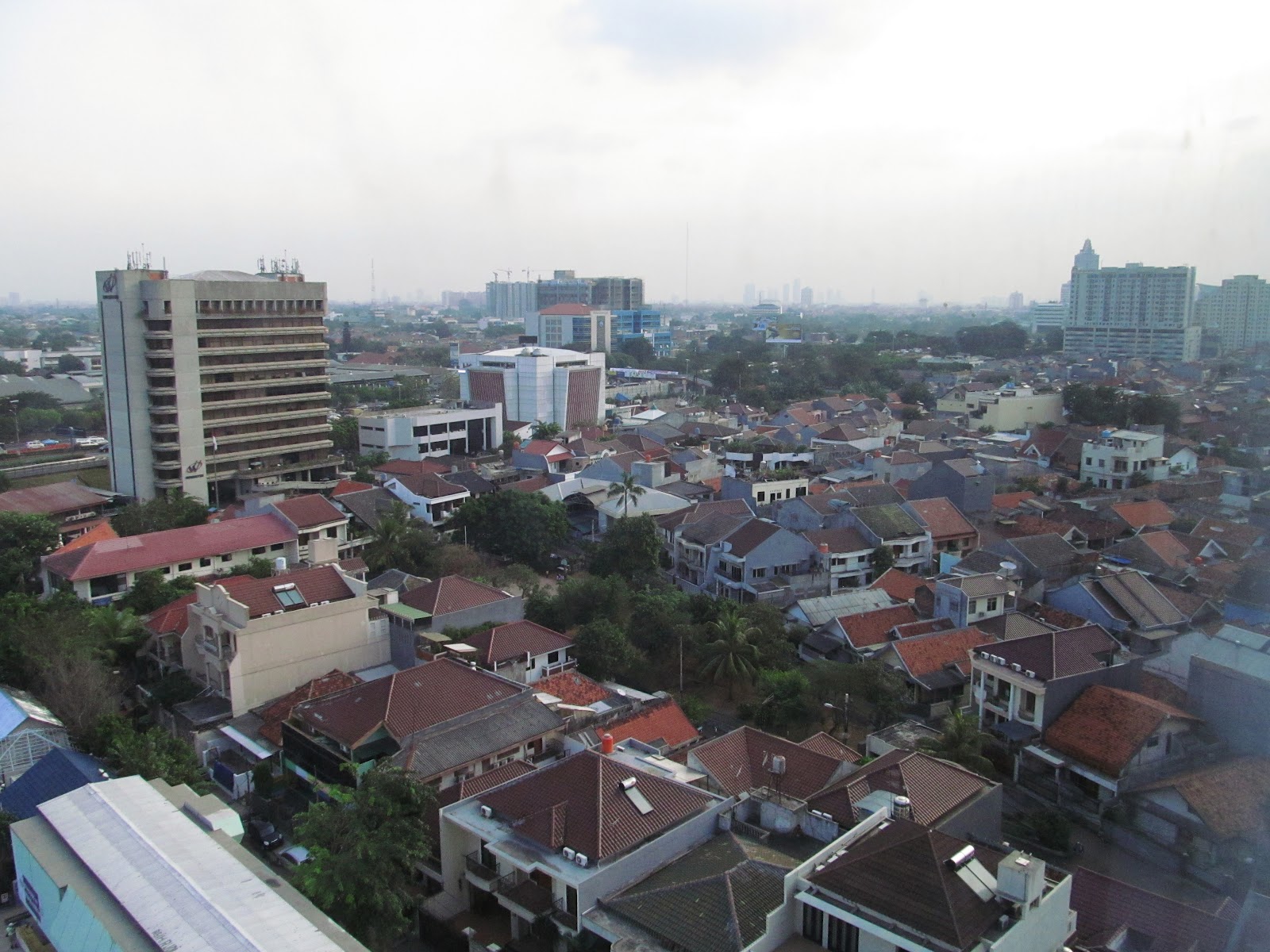
The view of Jakarta from my hotel room

Could Be Over the Rainbow

Finally!  It's my turn.  During the course of the spring and summer, I've followed the journeys of my colleagues in IREXs TGC 2012 program.  Cohorts of ten or eleven teachers each traveled in turn to Ghana, Morocco, Ukraine, Brazil, and India.  The final 2012 trip begins today. Fellow teachers from California, Colorado, Oklahoma, and Utah gather in Los Angeles by this evening to launch our 20 something hour flight over the Pacific Ocean.  It feels like stepping off a cliff and hoping I'll end up somewhere over the rainbow.  
Good-bye TJMS. 

Hellooo - airplane seat.  We're going to be spending a lot of time together, so let's get things straight, right from the start.  1)  I like the aisle seats.  2)  Need sleep.  3)  Need sleep.

Below is an overview of my route. 

A close up of arrival at Jakarta and then the hop to Mojokerto where my host school is.

Friday, July 13, 2012

The Small Beaded Bag and My Jolly Green Giant


"'When you say you've got the Cloak, and clothes...' said Harry, frowning at Hermione, who was carrying nothing except her small beaded handbag, in which she was now rummaging. 'Yes, they're here,' said Hermione, and to Harry and Ron's utter astonishment, she pulled out a pair of jeans, a sweatshirt, some maroon socks, and finally the silvery Invisibility Cloak... She gave the fragile-looking bag a little shake and it echoed like a cargo hold as a number of heavy objects rolled around inside it."
—Description[src]

The relevance of the need for a small beaded bag like Hermione's is finally clear.  Ah, that there could be such a magic bag in the muggle world!  For weeks my family has put up with scads of papers covering our kitchen table, mountains of indescribable objects with ambiguous and just-in-case purposes littering the floors of rooms in my house, and the back of my head as I work on my computer.  My daughter has even taken it upon herself to tell me when it's time to call it a day and head to bed.  Once my face appears in the bathroom mirror, and I begin to wash away the grime of the day, I could swear I see a faint bluish-green glow emanating from my skin (too much screen time). 
 
 
In my defense, reading the blog posts of my TGC colleagues who have and are currently traveling and teaching in their respective countries takes quite awhile.  It's IMPORTANT!  Call it research.  Moreover, working on my cultural presentations on California and its educational systems takes TIME. 
 
 
Preparing materials without knowing exactly how many students, educators, and hosts I will meet, what resources will be available, AND with the goal of keeping my suitcase within the airline's weight guidelines, is, I'm discovering, a matter of prayer, hours of strategic planning, and diligent list-making.  The first practice packing today revealed that, if I fit all the souvenirs and gifts into my jolly green giant of a suitcase, then I don't have any room for clothes.  Hmmm.  Everything back out.  Tomorrow I'll try packing clothes first.

There are but three and a half days before I catch the first leg of my flight.  GULP.  Must.  Be.  Ready.  Will.  Be.  Ready. 

All of this...


...has got to fit in here.  Sigh.

Jolly Green Giant
I sure could use that small beaded magic bag.


Sunday, July 1, 2012

Mistaking Indonesia

In the spirit of Curtis Keim's Mistaking Africa:  Curiosities and Inventions of the American Mind, a book I read before my trip to Senegal in 2010, I am determined to approach my trip to Indonesia by dropping any preconceived notions about its people and culture.  That's difficult to do.  For one thing, I am consuming reading material and have watched multiple videos in an effort to be prepared and to demonstrate my heartfelt interest in learning about the country.  If I heed my own classroom admonitions to my students, I'll remember that sources are written with a degree of bias; some greater than others.  For example, I love the PBS Globe Trekker series.  Its videos about Indonesia are very interesting and informative, but remembering that the show's producers likely edit out the mundane and opt for clips of its people and places that seem the most surprising and different to its (GT) audience, I've got to assume that there are more similarities between the U.S. and Indonesia than depicted in the videos.  Keim suggests that "Americans learn to understand Africans as they present themselves in all their diversity -- as "others" who are in fact not so different." (Gerhardt, March/April 2000)  I hope to learn to understand Indonesians as they present themselves, and discover the stories that are not, in fact, so different than mine.

A visual example of different perceptions, and sometimes misconceptions, can be seen by using Wordle.  Wordle is a cool e-tool that uses words or phrases submitted to configure a word cloud.  The words that appear larger were submitted many times.  Words that are smaller were suggested fewer times.  Amy, an English teacher from Massachusetts who traveled with me to Senegal, had her American students brainstorm words they thought of when they thought of Africa.  She then interviewed African teenagers and had them do the same.  After using those words to create word clouds, the students could see some similarities and differences in perspective.  I wanted to see what would happen when I posed the same task at my school.  See what you notice.

Amy's American students' brainstorm

African students' brainstorm
My middle school students' brainstorm
Besides Americans misconceptions about Indonesia, I wonder what myths I'll be able to bust that Indonesians believe about Americans.


Thursday, April 12, 2012

The Rest of the Story


I follow Indonesian news regularly in an effort to become acquainted with its culture.  The recent earthquake made world wide headlines.  Maybe you, like me, were reminded of the 2004 tsunami that caused great devastation and loss of lives.  Besides the fact that I grieve for people who endure loss and hardship, I am linked, in a tiny way, to the islands and its children.
Here's the rest of my story...
Years ago, when I was an elementary school teacher, the family of one of my students traveled to Bali.  When they returned they brought a great gift - letters from Indonesian students.  These letters were a glimpse into the lives of children who lived halfway around the world.  Adorned with beautiful and colorful artwork, and written in exquisite handwriting, the letters brought the daily lives of children in Bali to life.  They wrote of beaches and food, of friends and their pets.  Their favorite music and TV shows were surprisingly like ours.  Of course we wrote back.  It was great pressure to be sure that the quality of our writing was as good as the quality of the letters we had received.
Then came 2004.  It is said that 150,000 people were killed in what may be the deadliest tsunami in history...
I still have those letters.  They are tattered and worn.  Over the years, many of my students have read and discussed what it must be like to live in Bali.  Pulling out the letters to share with a new group of students is a joy.  Now these children will glimpse the lives of Balinese children, admire their beautiful artwork, and feel a bit sheepish about trying to measure up to the handwriting standards.  Great sadness and fear grips me as well.  It's the not knowing.  Picking up a letter, I think, "Is the child who wrote this one safe?"
~~~~~
With the promise of a visit to Indonesia in July, a fantasy forms.  What if?  It could happen.  Couldn't it?  What if I could actually find one of those children?

See more photos of Indonesia then and now. 

Nava's letter:

Sunday, March 4, 2012

Symposium Report

IREX Teachers for Global Classrooms has posted an article describing our February 16th and 17th symposium in Washington D.C.  It's very exciting to be a part of the very first gathering of teachers and administrators from 32 states to discuss what it means for students in the U.S. to be globally competent.

Tuesday, February 21, 2012

Teachers for Global Classrooms Program (TGC) | IREX

If the journey I've begun looks interesting to you, and you're an educator, there's still time to apply for the next cycle. Look into it at: Teachers for Global Classrooms Program (TGC) IREX The application deadline is March 12th, 2012.

Sunday, February 19, 2012

Wait For It...

In Washington D.C., February, 2012
I wouldn’t call myself a seasoned traveler.  Not yet.  But I have developed some real skills when it comes to handling wait time in airports and chunking flying time into bits that allow for the mental fortitude necessary as I mark progress toward my destination.   After walking up and down terminal C, browsing shops, and purchasing an iced coffee, I’ve set about the business of reading emails, Facebook posts, and updating my blog.  Why am I killing time at the airport?  Ah, there’s the real story.


Part of the process of preparing for my study trip to Indonesia is participation in the IREX Teachers for Global Classrooms symposium in Washington D.C.   In the history books by now, this event included lots of important pre-travel work.  I was finally able to meet many of my online classmates and IREX staff members face-to-face!  They are a great bunch of positive and energetic people, and together they represent a wealth of expertise and ideas for improving classroom teaching and learning.  
IREX invited my administrator to this informational symposium.  What a boon that turned out to be!  We were able to dedicate a significant amount of time to discussing and planning the process for implementing elements of global education at our own school site.  That kind of opportunity doesn’t present itself in the normal course of a busy school day. 
I attended useful sessions on day one in which teachers were grouped by the subjects they teach in order to collaboratively analyze student work from each of our respective classrooms for global elements.  The second breakout session was intended to facilitate the forming our “essential” questions.  These individualized questions will provide focus as we visit our host countries to observe and participate in the education systems.  These sessions were important in that the ground work we are doing will enrich and enhance the experience we eventually have during travel.  But the highlights came on day two.
In discussing general cultural differences on day two, we recognized that some assumptions we will make about social norms in our host countries may be off-target and that we need to be FLEXIBLE!  Finally, regrouped with our traveling cohorts, we got to ask the questions that have been foremost in our minds.  What should we wear?  Where will we stay?  What shots will we need?  What are the ages of the students we will meet?  ILEP international teachers shared information about their home countries and fielded our gazillion questions. 
Spending a couple of days in our nation’s capital was great.  But time marches on, and the party’s over.  So I wait.  As I finish up this post, I am in the air heading back home, mentally chunking the hours into bits that I can handle.  Listen to iPod.  Read a little.  Work on blog.  Try to sleep.  Stand up to stretch.  Repeat.

Saturday, February 11, 2012

Hitting a Mile Marker

Early on I learned that I should watch my progress by looking at the accomplishment of small steps toward a larger goal.  That works for intangible goals as well as marathon vacation trips via automobile.  Yes!  I've made it to Stockton.  Now only another hour to Turlock.  And so on.  Ah, so... In this journey, which is no longer just to Indonesia, but to the person I am becoming by preparing for this journey, I am celebrating the mile markers reached. 


Rewind... To earn the opportunity to study and travel with IREXs TGC program, I completed an extensive competitive application by June of 2011.  By last fall, I think it was September, I learned that I had been selected as one of 65 teachers in the United States to participate.   Mile marker #1 - Check!  Next?
I was not yet assured of a spot on the roster of travelers.  First, I had to successfully complete an eight-week online course.  Okay, I thought, let's get this party started.  ---  In retrospect, it's a good thing I began the course with that kind of determination, because as the days and assignments wore on, I began to falter.  Teaching is a profession that requires 100% of one's body, mind, and soul.  After "giving at the office," coming home to hours of homework for my online class was consuming any energy reserves I may have had left.  As I struggled to learn to use the online course platform, find the time to complete the readings, and to meet deadlines for assignments, I developed great empathy for my students' similar struggles.  Finally, December arrived and the course was completed.  Just as my students wait impatiently for their test scores, I held my breath to see if I had qualified to travel to a host country.  Yes!  Mile marker #2 - Check!  Next?
Next turned out to be the draft of my capstone project.  This project will contain several elements including the global education unit I am developing, the blog you are reading at this very moment, and a variety of resource inventories.  Deadline:  February 11th.  Stress..  Screen time.  Checking in with colleagues at our social networking site.  Research.  Stress.  Almost midnight on due date.  Click.  Whew!  Mile marker #3.  Next?